Why Do We Celebrate Bonfire Night? The True Story of the Gunpowder Plot (1605)
Every autumn across the United Kingdom, millions of people gather around roaring bonfires, light glowing sparklers, and gaze at spectacular fireworks illuminating the cold November skies. Celebrated annually on 5th November, Bonfire Night (also widely known as Guy Fawkes Night) is one of Britain’s oldest, most dramatic, and enduring national traditions.
Yet behind the festive carnival atmosphere of toffee apples and pyrotechnics lies the dark, true story of a high-stakes conspiracy that nearly altered the course of world history: the Gunpowder Plot of 1605.
The Legendary 5th of November Rhyme:
"Remember, remember the fifth of November,
Gunpowder, treason and plot.
I see no reason why Gunpowder treason
Should ever be forgot."
To understand why bonfires still burn four centuries later, we must travel back to Jacobean London in the turbulent autumn of 1605.
⚔️ The Historical Background: Religious Turmoil in Jacobean England
| Key Plot Dimension | Historical Fact | Significance & Context |
|---|---|---|
| Date of Discovery | Midnight, 4th/5th November 1605 | Foiled hours before the State Opening of Parliament |
| Conspiracy Mastermind | Robert Catesby | Charismatic Warwickshire gentleman who organized the plot |
| Explosives Specialist | Guy (Guido) Fawkes | Seasoned military veteran recruited for demolition expertise |
| Gunpowder Quantity | 36 wooden barrels (~2,500 kg / 2.5 tonnes) | Massive payload capable of leveling Westminster Palace |
| Target Location | Undercroft directly beneath House of Lords | Positioned to eliminate the King, Lords, and Commons |
| Ultimate Objective | Overthrow the Protestant regime | Install 9-year-old Princess Elizabeth as Catholic monarch |
The roots of the Gunpowder Plot lay in intense religious conflict following the English Reformation. Under Queen Elizabeth I (who reigned from 1558 to 1603), Roman Catholics in England faced severe persecution, heavy fines (recusancy fees) for failing to attend Anglican services, and the threat of execution for practicing priests.
When Elizabeth died childless in March 1603, King James VI of Scotland ascended the English throne as King James I. English Catholics initially hoped the new monarch—whose mother, Mary Queen of Scots, was Catholic—would usher in religious tolerance.
However, by early 1604, James I dashed these hopes by ordering all Catholic priests to leave England and vigorously reinstating heavy penal fines. Frustrated by decades of state oppression, a radical group of provincial Catholic gentlemen decided that peaceful petitioning was futile. They resolved to strike a catastrophic blow at the heart of the British establishment.
👥 The Conspirators: Robert Catesby & Guy Fawkes
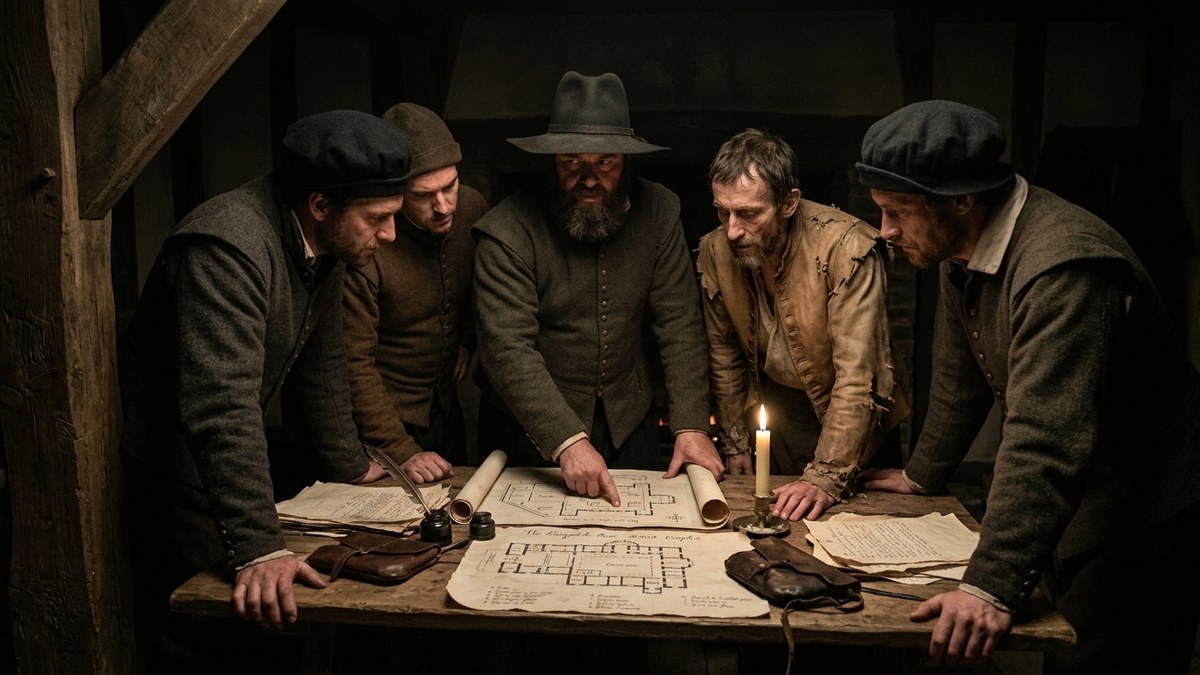
While history remembers Guy Fawkes as the face of the treason, he was not the mastermind. The conspiracy was conceived, financed, and directed by Robert Catesby, a charismatic and fiercely committed Catholic gentleman from Warwickshire.
| Conspirator | Background & Crucial Role in the Plot |
|---|---|
| Robert Catesby | The Mastermind: Conceived the plan to destroy Parliament, financed operations, and recruited co-conspirators. |
| Guy (Guido) Fawkes | The Explosives Expert: Born in York, convert to Catholicism, seasoned military veteran in the Spanish Netherlands recruited for pyrotechnic expertise. |
| Thomas Wintour | The Diplomat: Catesby's right-hand man who travelled to Flanders to enlist Fawkes into the conspiracy. |
| Thomas Percy | The Insider: Kin to the Earl of Northumberland; leased the townhouse and cellar directly beneath the House of Lords. |
| John & Christopher Wright | The Loyal Swordsmen: Renowned fencers and schoolfellows of Fawkes from St Peter's School in York. |
| Francis Tresham | The Wealthy Cousin: Recruited late for funds; widely suspected of sending the betrayal letter to Lord Monteagle. |
In total, 13 conspirators joined the plot. Their objective was audacious: to assassinate King James I, his eldest son Prince Henry, the Privy Council, and both Houses of Parliament during the grand State Opening on 5th November 1605. In the ensuing power vacuum, they planned to seize the King's young daughter, Princess Elizabeth, install her as a puppet Catholic monarch, and ignite a national uprising.
💣 The Plan: 36 Barrels of Gunpowder Beneath the House of Lords
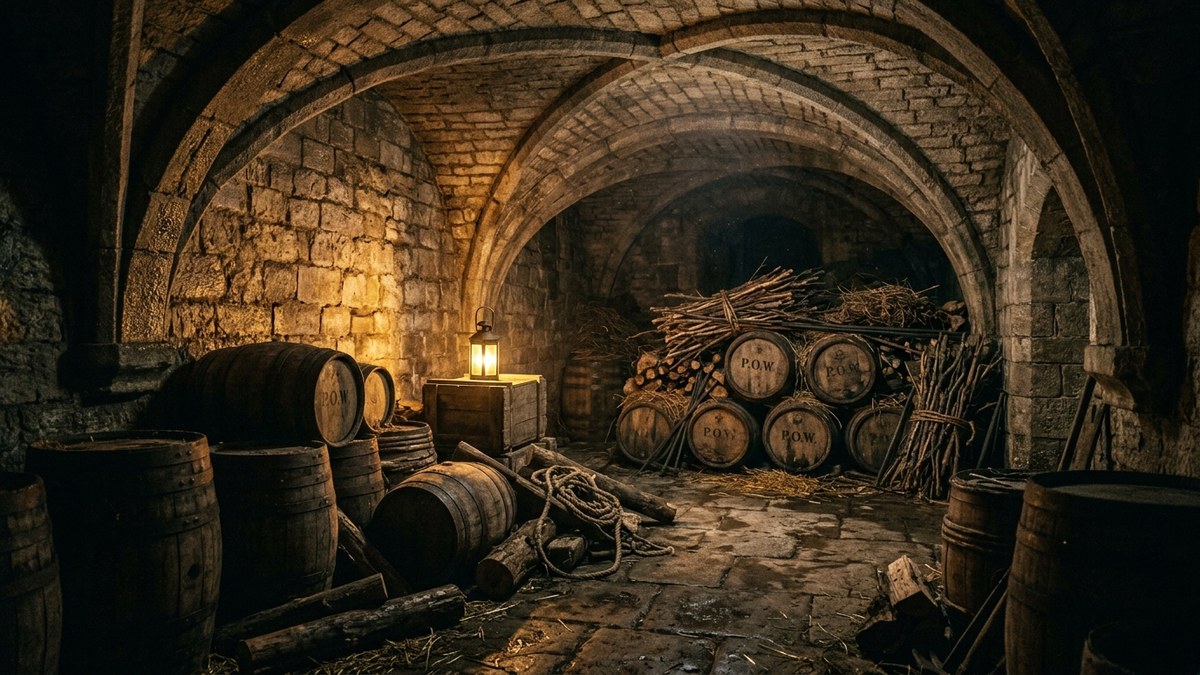
In May 1604, Thomas Percy leased a small property adjacent to the Palace of Westminster. In early 1605, an extraordinary stroke of luck favoured the plotters: the tenant of the ground-floor undercroft directly beneath the House of Lords chamber vacated the premises. Percy immediately leased the cellar.
🏛️ The Undercroft Vault: Positioned directly below the throne and benches of the House of Lords chamber, the stone cellar allowed the conspirators to place explosive charges directly under King James I, Queen Anne, the royal heirs, and all peers of the realm assembled for the State Opening.
Under cover of darkness, Guy Fawkes (posing as Percy's servant under the pseudonym "John Johnson") smuggled 36 wooden barrels containing approximately 2,500 kg (2.5 tonnes) of gunpowder across the River Thames from Lambeth into the cellar.
To conceal the explosives from prying eyes, Fawkes stacked bundles of firewood (faggots), timber logs, and heavy iron bars over the barrels. Had the gunpowder detonated, the blast would have obliterated the entire Palace of Westminster, shattered stained glass windows at Westminster Abbey hundreds of yards away, and killed everyone inside.
Fawkes was assigned the perilous final task: to light a slow-burning fuse on the morning of 5th November, escape across the Thames by rowing boat, and sail to Flanders to rally military support.
📜 The Betrayal: The Mysterious Monteagle Letter
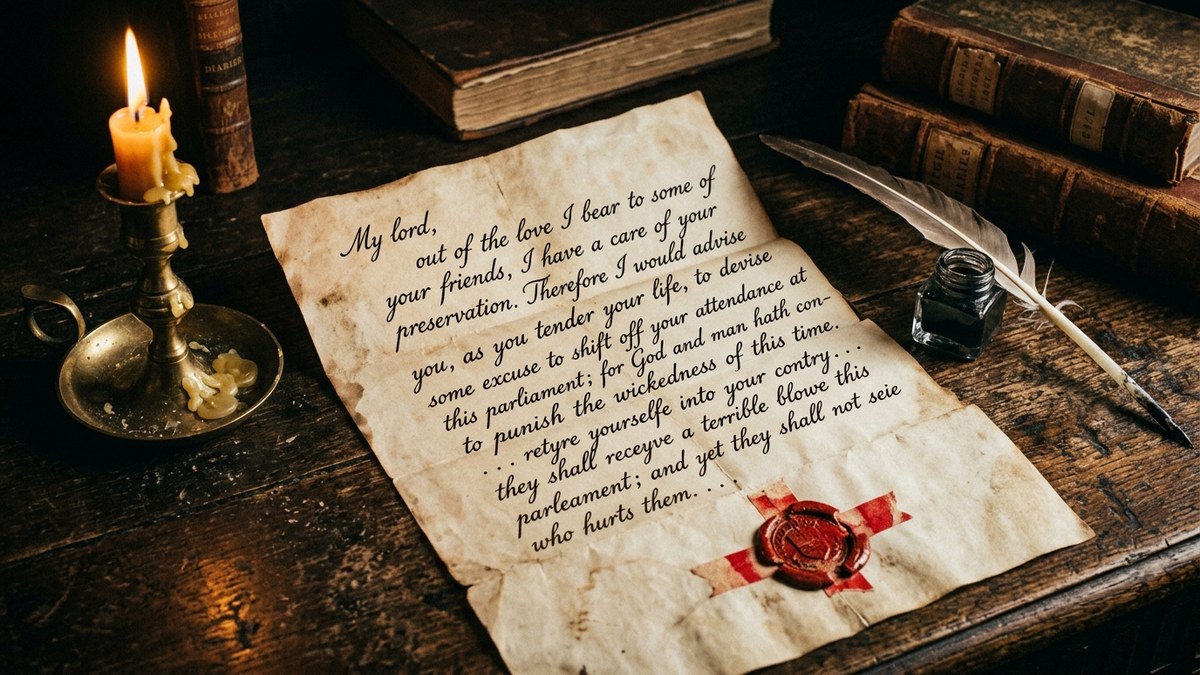
The plot began to unravel on the evening of 26th October 1605. Lord Monteagle, a prominent Catholic peer, was hosting dinner at his house in Hoxton when a servant delivered an anonymous letter handed to him by a cloaked stranger on the street.
The letter contained a chilling, cryptic warning:
"My lord, out of the love I bear to some of your friends, I have a care of your preservation. Therefore I would advise you, as you tender your life, to devise some excuse to shift off your attendance at this parliament; for God and man hath concurred to punish the wickedness of this time... they shall receive a terrible blow this parliament, and yet they shall not see who hurts them."
Monteagle immediately rode to Whitehall Palace and delivered the letter to Robert Cecil, Earl of Salisbury, the King's Secretary of State. Cecil showed the letter to King James I upon his return from a hunting trip in Royston. The King, acutely aware of how his own father (Lord Darnley) had been killed in an explosion in 1567, deduced that the "terrible blow" signified an explosion of gunpowder.
🕯️ The Midnight Raid: Guy Fawkes Captured Red-Handed
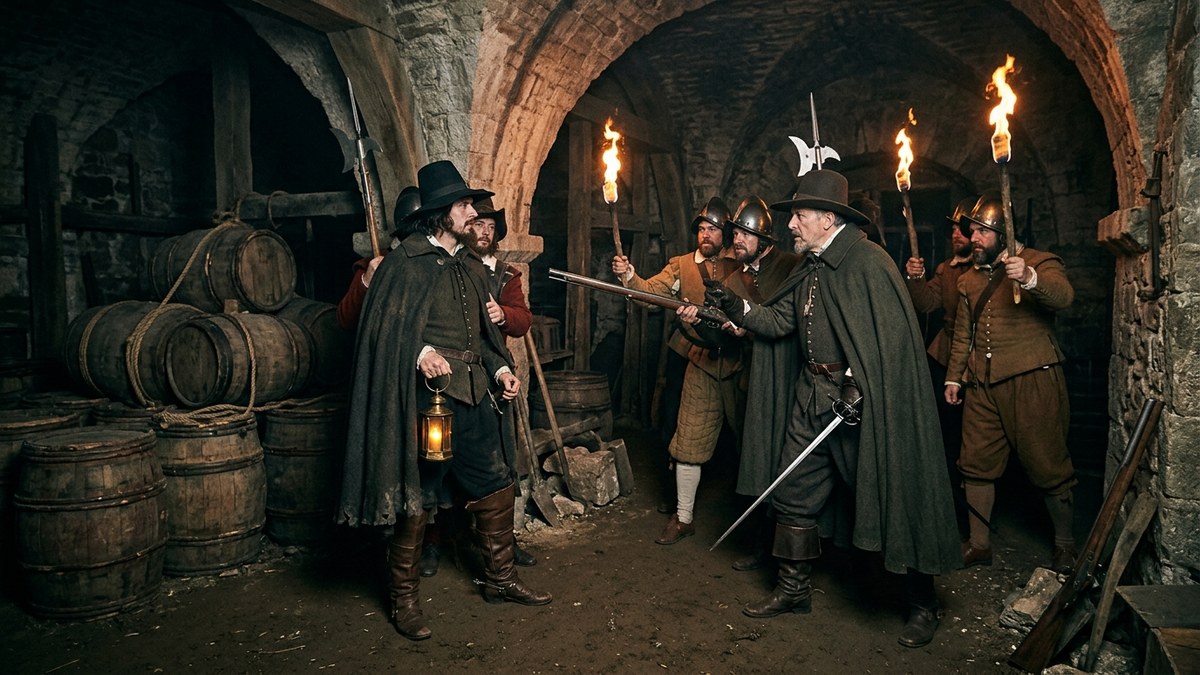
Around midnight on the night of 4th/5th November 1605, a search party led by Sir Thomas Knyvett, Justice of the Peace for Westminster, conducted a second, thorough raid of the undercrofts beneath Parliament.
Stepping into the shadows of the cellar, the armed royal guards caught Guy Fawkes just as he was preparing the fuses for the morning. Dressed in a dark travelling cloak, tall leather riding boots with spurs, and a broad-brimmed felt hat, Fawkes was carrying:
- A pocket watch (to time the explosion precisely),
- A dark brass lantern,
- Slow-burning touchwood matches and fuses.
When guards removed the bundles of firewood, they uncovered all 36 barrels of gunpowder. Fawkes was arrested on the spot and dragged directly to the royal bedchamber at Whitehall Palace for interrogation in the early morning hours.
🏰 The Tower of London, The Rack, and The Traitors' Fate
When interrogated before King James I, Fawkes remained fiercely defiant. When asked by a Scottish nobleman why he needed so much gunpowder, Fawkes famously retorted:
"One of my objects was to blow you Scotch beggars back into your native mountains!"
Fawkes was transferred to the Tower of London and confined in the infamous subterranean dungeon known as the White Tower. King James I issued a direct royal warrant permitting the use of torture:
"The gentler tortures are first to be used unto him, and so by degrees proceeding to the worst."
| Conspirator | Fate & Judicial Outcome | Historical Circumstances |
|---|---|---|
| Guy Fawkes | Executed 31st January 1606 | Leapt from the gallows ladder at Westminster, breaking his neck instantly |
| Robert Catesby | Killed in action, 8th November 1605 | Shot dead during siege at Holbeche House, Staffordshire |
| Thomas Percy | Killed in action, 8th November 1605 | Struck down by the same musket ball as Catesby at Holbeche |
| Thomas Wintour | Executed 31st January 1606 | Convicted of high treason and executed opposite Parliament |
| Francis Tresham | Died of illness, 23rd December 1605 | Succumbed to illness in the Tower of London before trial |
After suffering days of agonizing agony on the rack, Fawkes' spirit broke. On 8th November 1605, he signed a full confession. The physical toll of the torture was painfully evident on the document: his once-steady signature was reduced to a faint, broken scrawl: "Guido".
Meanwhile, Robert Catesby and the remaining conspirators fled London into the Midlands. On 8th November, royal forces cornered them at Holbeche House in Staffordshire. A gunfight erupted; Catesby and Thomas Percy were killed by a single musket ball while standing back-to-back.
In January 1606, surviving conspirators were tried for high treason in Westminster Hall and sentenced to be hanged, drawn, and quartered. On 31st January 1606, as Guy Fawkes was led to the scaffold opposite the Parliament building he had intended to destroy, he leapt from the ladder, breaking his neck and dying instantly, sparing himself the agony of the quartering.
🔥 How Bonfire Night Became an Annual National Tradition
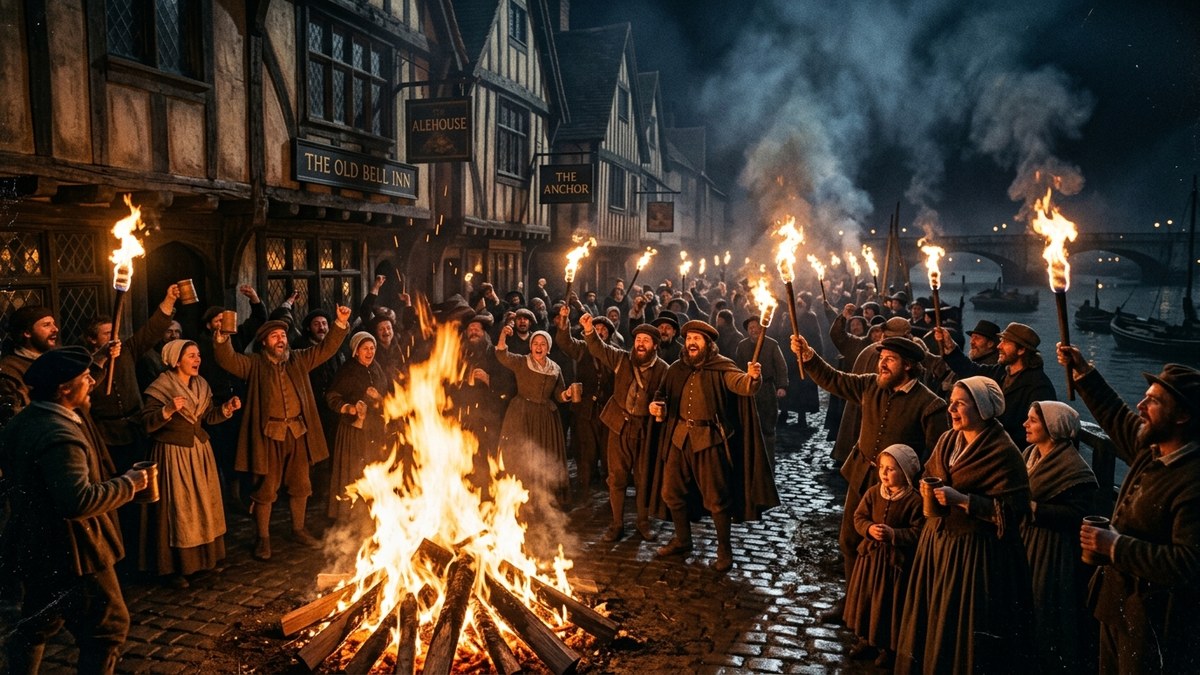
Immediately following the discovery of the conspiracy on the morning of 5th November 1605, delighted Londoners lit celebratory street bonfires across the capital to celebrate the miraculous survival of the King and Parliament.
In January 1606, Parliament passed the Observance of 5th November Act 1605 (also known as the Thanksgiving Act). The legislation made 5th November an official annual public holiday:
- Church of England congregations were legally required to hold annual thanksgiving sermons every 5th November.
- Citizens were encouraged to light joyful street bonfires and ring church bells.
The Evolution Across 400 Years: From Politics to Community Festival
Over the centuries, the character of Bonfire Night shifted profoundly:
- 17th & 18th Century: Celebrations were politically charged and fiercely anti-papal, with effigies of Guy Fawkes, the Pope, and foreign rivals burned on bonfires.
- 19th Century: In 1859, the compulsory Thanksgiving Act was officially repealed by Parliament. The holiday transitioned into a popular Victorian street festival featuring fireworks, costumed processions, and the children's custom of collecting "Penny for the Guy".
- 20th Century to Present: Today, Bonfire Night has transformed into an inclusive, family-oriented autumn cultural celebration. It is a festive night of community togetherness, roaring fires, traditional Yorkshire Parkin, toffee apples, and dazzling municipal fireworks spectaculars.
💂 Living History Today: The Yeomen of the Guard Cellar Search
The memory of the 1605 Gunpowder Plot remains an active part of British constitutional ceremony:
Every year, before the monarch enters the Palace of Westminster for the State Opening of Parliament, the Yeomen of the Guard (the Sovereign's ceremonial bodyguard in Tudor uniforms) conduct a formal, lantern-lit search of the cellars beneath Parliament.
While today the ritual is purely ceremonial, it serves as a living reminder of the chilly November night in 1605 when the fate of Britain hung by a single fuse.
❓ Frequently Asked Questions (FAQ)
Was Guy Fawkes the leader of the Gunpowder Plot?
No. The true mastermind, leader, and financier of the conspiracy was Robert Catesby. Guy Fawkes was recruited specifically for his military expertise with explosives and black powder.
How much gunpowder was placed under Parliament?
The conspirators concealed 36 barrels containing approximately 2,500 kg (2.5 tonnes) of gunpowder beneath the House of Lords chamber—more than enough to obliterate Westminster Palace and surrounding districts.
What happened to the Monteagle letter?
The original 1605 Monteagle letter is preserved in the UK National Archives at Kew, Surrey, where it remains on display as one of the most famous documents in British history.
Why do we burn an effigy called "the Guy"?
Historically, children created straw-and-cloth effigies representing Guy Fawkes, asking passersby for a "Penny for the Guy" to buy fireworks. The effigy is ceremoniously placed atop the bonfire to symbolize the destruction of the treasonous plot.
🌟 Explore More About Bonfire Night 2026
- Discover the food & rituals: Bonfire Night Traditions, Food & Safety Guide
- Find fireworks near you: Browse Bonfire Night Events by County
- Explore major hotspots: Greater London Displays | East Sussex Displays (Lewes & Battle)